
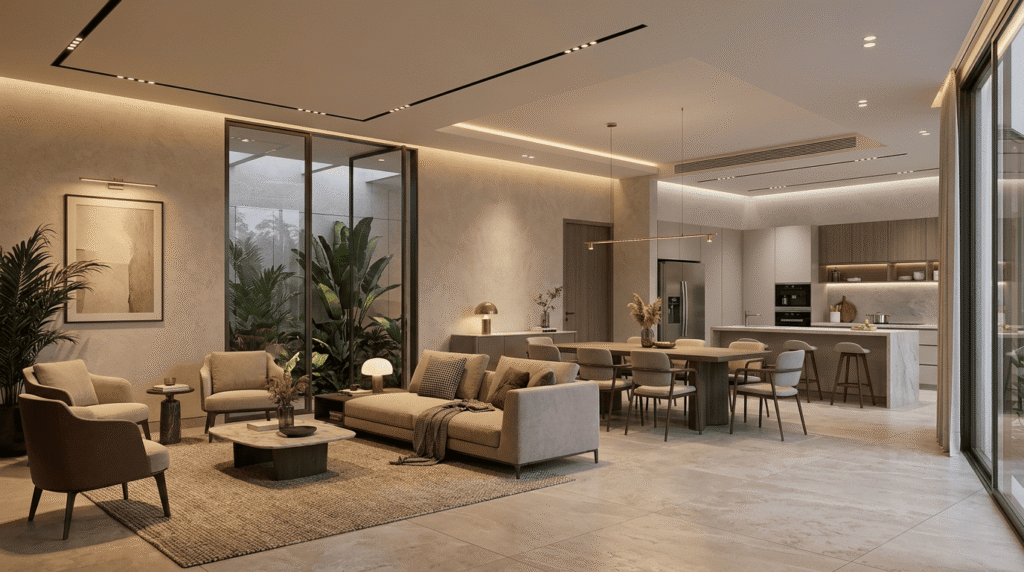
Colour Temperature Guide in sync with Circadian Rhythm
| Time of Day | Recommended Colour Temperature | Best For | Circadian Effect |
| Sunrise – 10 AM | 4000K–6500K | Kitchen, Home Office, Study Areas | Boosts alertness and helps regulate your body clock |
| 10 AM – 4 PM | 4000K–5000K | Workspaces, Living Areas | Maintains focus, energy, and productivity |
| 4 PM – Sunset | 3000K–4000K | Living Room, Dining Room | Signals the body to begin winding down |
| After Sunset | 2700K–3000K | Living Room, Bedrooms | Supports melatonin production and relaxation |
| 1–2 Hours Before Bed | 2200K–2700K | Bedrooms, Reading Areas | Prepares the body for sleep |
| Overnight (if needed) | 1800K–2200K | Night Lights, Hallways, Bathrooms | Minimizes sleep disruption during nighttime movement |
CRI Guide: The Number That Changes How Colours Look
What Is CRI?
CRI stands for Colour Rendering Index.
It is a score from 0 to 100 that measures how accurately a light source reveals colour compared to a reference light source of the same warmth.
A CRI of 100 represents the most accurate colour rendering. The lower the CRI, the more colours can appear muted, distorted, or less vibrant than they actually are.
In simple terms: brightness tells you how much light you have. CRI tells you how accurately you see colour.
Why Does CRI Matter?
Two lights can have the same brightness, the same wattage, and the same colour temperature — yet make a room look completely different.
A low-CRI light can make:
• Fabrics look dull
• Wood finishes lose depth
• Food appear less appetising
• Paint colours look different from the swatch
• Skin tones appear tired or unnatural
A high-CRI light reveals colours, textures, and finishes the way they were intended to be seen.
Understanding CRI Ratings
| CRI Range | Suitability | Examples |
| Below 80 | Basic illumination where colour accuracy is not critical | Utility areas, storage spaces, service areas |
| 80–89 | Good colour rendering for general applications | Corridors, staircases, common circulation spaces |
| 90+ | Recommended wherever colour quality matters | Homes, restaurants, retail environments, hospitality spaces, art and display areas |
How to Use CRI in Indian Homes
Living Room
Recommended: 90+ CRI
Living rooms often combine multiple materials and finishes, from wood and stone to fabrics and artwork. A high CRI helps these colours and textures appear richer and more natural.
Dining Area
Recommended: 90+ CRI
Food presentation is heavily influenced by light quality. Higher CRI lighting makes ingredients and meals appear fresher and more vibrant.
Kitchen
Recommended: 90+ CRI
Accurate colour perception helps while cooking and preparing food, making it easier to distinguish ingredients and assess freshness.
Bedroom
Recommended: 90+ CRI
High CRI lighting improves the appearance of fabrics, finishes, and skin tones, creating a more comfortable and natural environment.
Wardrobes & Dressing Areas
Recommended: 90+ CRI
Colours of clothing can appear very different under poor-quality lighting. High CRI lighting helps ensure what you see indoors is closer to how colours appear in daylight.
Bathrooms & Vanity Mirrors
Recommended: 90+ CRI
Accurate colour rendering is especially important for grooming, makeup application, and personal care.
Study & Home Office
Recommended: 80–90+ CRI
Good colour rendering supports visual comfort and provides a more natural appearance during video calls and long work sessions.
CRI vs Colour Temperature
One of the most common misconceptions is that warm light automatically means good light. It doesn’t.
A warm 3000K light can have poor colour rendering. A neutral 4000K light can have excellent colour rendering.
Colour temperature tells you whether light appears warm or cool. CRI tells you how accurately that light reveals colour. Both are important, but they measure completely different things.
Before You Buy Your Next Light
Ask these three questions:
Where is the light being used? Prioritise high CRI in living areas, dining spaces, bedrooms, wardrobes, and bathrooms where people, materials, and colours are meant to be appreciated.
What is the CRI? For most homes, look for 90+ CRI in spaces where colour quality matters.
What is the colour temperature? Choose a colour temperature appropriate for the space, but don’t assume it guarantees good colour rendering.
The Takeaway
If colours look dull, flat, or different from what you expected, brightness may not be the issue. The missing piece could be CRI.
When evaluating a light, don’t just ask how bright it is. Ask how accurately it shows colour.
Room-by-Room Guide
Here is how to apply the light layering to each key room in an Indian home.
Drawing Room
· Ambient Evenly spaced downlights or cove lighting, on a dimmer.
· Task A floor lamp or reading lamp near the seating area.
· Accent Spotlights on the feature wall, display unit, or artwork.
· Decorative A statement pendant or chandelier at the centre.
The single most impactful change
Split your drawing room into two circuits: one for the main downlights, one for the accent and feature lights. Add a dimmer on the first. This one wiring decision transforms how the room feels at every hour.
Kitchen
· Ambient LED panels or downlights at 4000K for even overall light.
· Task Under-cabinet LED strips above every counter and hob. This is a safety requirement.
· Accent A small spotlight inside open shelving for a considered look.
The highest-impact kitchen upgrade
Under-cabinet strips eliminate the shadow your body casts on the counter when working under an overhead light. They cost under Rs 2,000 to install and make an immediate difference.
Master Bedroom
· Ambient Cove lighting or soft downlights on a dimmer.
· Task Wall-mounted bedside reading lights, switchable independently for each side.
· Accent Wardrobe interior light, vanity mirror light, or a spotlight on a piece of art.
· Decorative A bedside pendant or table lamp that reflects the character of the space.
Children’s Room
· Ambient Bright ceiling light at 4000K for play and study.
· Task A dedicated adjustable desk lamp with CRI 90+ for homework.
· Night A warm 2700K nightlight or dimmable bedside lamp for evenings.
Blue light affects children’s sleep
LED bulbs above 5000K emit blue light that makes it harder to fall asleep. After 7pm, switch all lighting in the children’s room to warm white (2700K to 3000K).
Pooja Room
· Ambient A small warm recessed downlight or LED panel at 2700K.
· Task A focused downlight directly above the idol shelf.
· Accent A warm LED strip inside the shelf recess, creating a soft halo behind the idols.
Bathroom
· Ambient A ceiling downlight or LED panel at 4000K.
· Task Side-lit mirror lighting above the washbasin. Top-lit mirrors create unflattering shadows.
· Accent A warm LED strip beneath the vanity for a hotel-style effect.
IP ratings are a safety standard
Any fitting within 60 cm of water needs IP44 minimum. Above a shower or in a wet zone: IP65 or IP67. Specify this when buying any bathroom or kitchen fitting.
Balcony
· Ambient An IP44-rated wall or ceiling fitting for general visibility.
· Accent String lights along the railing or uplighters into plants for atmosphere.
Lighting Terms Made Simple
You will see these words when buying lighting. Here is what they mean.
| Term | What it means | What to look for |
| Colour Temperature (K) | How warm or cool the light looks. | 2700K-3000K for living rooms and bedrooms. 4000K for kitchens, studies and workspaces. |
| Lumens (lm) | The actual amount of light a fixture produces. | Compare lumens when comparing brightness, not watts. |
| Wattage (W) | How much electricity a light uses. | Lower watts with high lumens usually means better efficiency. |
| CRI (Colour Rendering Index) | How accurately colours appear under the light. | 80+ for general use. 90+ for kitchens, wardrobes, artwork and retail. |
| Beam Angle | How wide or narrow the light spreads. | 15°-24° for highlighting objects. 36°-60° for general lighting. |
| Lux (lx) | How much light reaches a surface like a desk or floor. | Higher lux for tasks like reading, cooking and working. |
| Voltage (V) | The electrical pressure used to power the light. | 12V and 24V are common for LED strips. Voltage does not affect brightness. |
| Dimmable | Whether the light can be dimmed. | Check that both the fixture and dimmer are compatible. |
| Driver | The component that powers and controls an LED. | Good drivers improve lifespan, dimming performance and flicker control. |
| Flicker | Small fluctuations in light output that may not always be visible. | Look for flicker-free or low-flicker fixtures, especially for workspaces. |
| Glare | Uncomfortable brightness that causes eye strain. | Choose fixtures with deep recesses, diffusers or glare-control optics. |
| UGR | A rating that measures visual comfort and glare. | Lower numbers mean less glare. UGR <19 is preferred for offices and workspaces. |
| IP Rating | Protection against dust and water. | IP20 for dry areas. IP44 for bathrooms. IP65+ for outdoor use. |
| LED Strip | A flexible strip containing multiple LEDs. | Check colour consistency, CRI and voltage before buying. |
| Linear Lighting | A continuous line of light instead of individual spots. | Ideal for modern ceilings, corridors, shelves and joinery. |
| Downlight | A ceiling light that directs light downward. | Use the correct spacing and beam angle to avoid dark patches. |
| Spotlight | A focused light used to highlight a specific area or object. | Best for artwork, textures, display units and feature walls. |
| Wall Washer | A light designed to evenly illuminate a wall. | Great for making spaces feel larger and brighter. |
| Wall Grazer | A light designed to highlight texture on a wall. | Ideal for stone, brick, wood and textured finishes. |
| Ambient Lighting | The main layer of light that illuminates a space. | Forms the foundation of the lighting design. |
| Task Lighting | Lighting designed for a specific activity. | Use over kitchen counters, desks, mirrors and reading areas. |
| Accent Lighting | Lighting used to create focus and visual interest. | Use to highlight artwork, architecture or decorative elements. |
| Cove Lighting | Hidden lighting that reflects light off ceilings or walls. | Creates a soft, premium and glare-free effect. |
| Recessed Lighting | Fixtures installed flush within the ceiling. | Creates a clean and minimalist appearance. |
| Surface Mounted Lighting | Fixtures mounted directly onto the ceiling or wall. | Useful where recessed installation is not possible. |
| Pendant Light | A light fixture suspended from the ceiling. | Common above dining tables, islands and reception desks. |
| Efficacy (lm/W) | How efficiently a light converts electricity into illumination. | Higher lumens per watt generally means better energy efficiency. |
| Constant Voltage | An LED system that operates at a fixed voltage. | Common for LED strips and linear lighting systems. |