
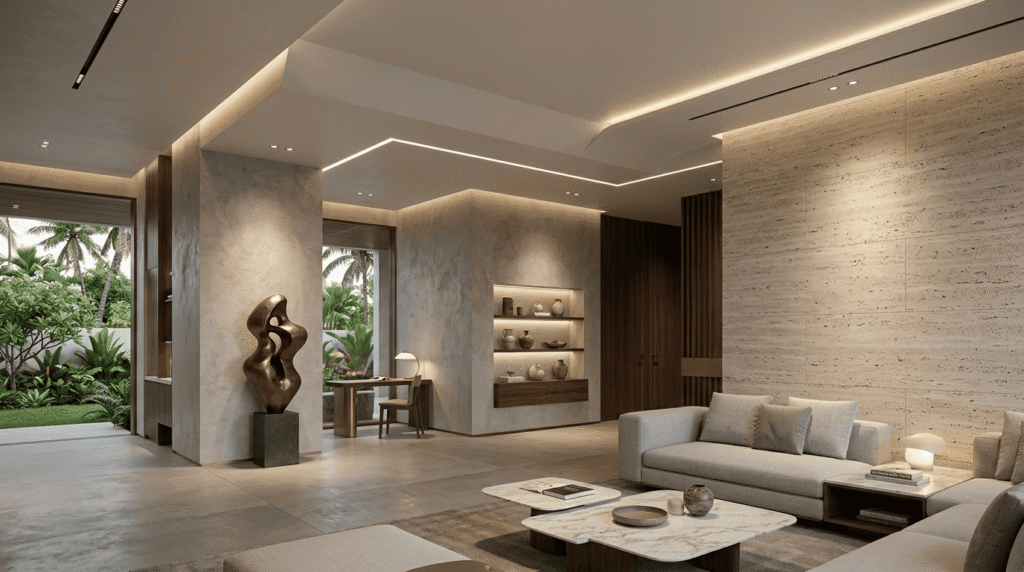
Architectural lighting design merges the functionality of lighting design with the aesthetics of architecture; it utilizes light as a way to highlight or emphasize a space’s architecture. Light plays a big role when it comes to people’s perception of an environment – think of a scary movie with a dark hallway and flickering overhead light; that setting, a hallway, isn’t necessarily scary, but the light – or lack thereof – is what makes it creepy.
Principles of Architectural Lighting Design
1. Aesthetics
Aesthetics can be defined as the beauty of something, and given the role that aesthetics plays in the field of architecture, it’s no wonder it’s important for architectural lighting. By drawing inspiration from key points of an environment, architectural lighting designers are able to place lighting fixtures in places that accentuate the space they’re illuminating.
2. Function
Functionality is, of course, still part of the main goal when it comes to lighting a space. In restaurants, customers should be welcomed by the ambiance while still being able to read the menu. The same thing to office spaces; workers should be able to stay alert and focused and not be distracted by overbearing lights that can cause headaches or even migraines.
3. Balance
Achieving visual balance in architectural lighting design involves distributing light sources evenly throughout a space to create a sense of equilibrium and harmony. Strategically balancing illumination levels and contrast ratios, designers can minimize visual fatigue, optimize task performance, and enhance spatial legibility.
4. Contrast
Contrast plays a pivotal role in architectural lighting design, defining spatial hierarchy, emphasizing focal points, and adding drama to built environments. Juxtaposing areas of brightness and darkness, designers can create dynamic visual compositions that capture attention and evoke emotional responses.
5. Uniformity
Achieving uniformity in lighting distribution ensures consistent illumination levels and visual comfort across all areas of a space, minimizing glare, shadows, and visual distractions. Uniform lighting promotes overall homogeneity in space, enhances visual clarity, and fosters a sense of tranquillity within interiors.
Uniform lighting facilitates task performance, supports way finding, and promotes a sense of safety and well-being among occupants. Through careful selection and placement of luminaires, designers can achieve optimal uniformity while preserving architectural integrity and design intent.
6. Efficiency
Nowadays, efficiency is the combination of energy-saving and sustainable fixtures. This can be seen in the shift from Halogen lamps to LED lights, as LED lights tend to be much more cost-effective – they generally use 80% less energy than Halogen lamps, have a longer life, and can be much brighter than their older counterparts.